Shaping the Document, Not the Model: Optimized Suffixes for Context Following
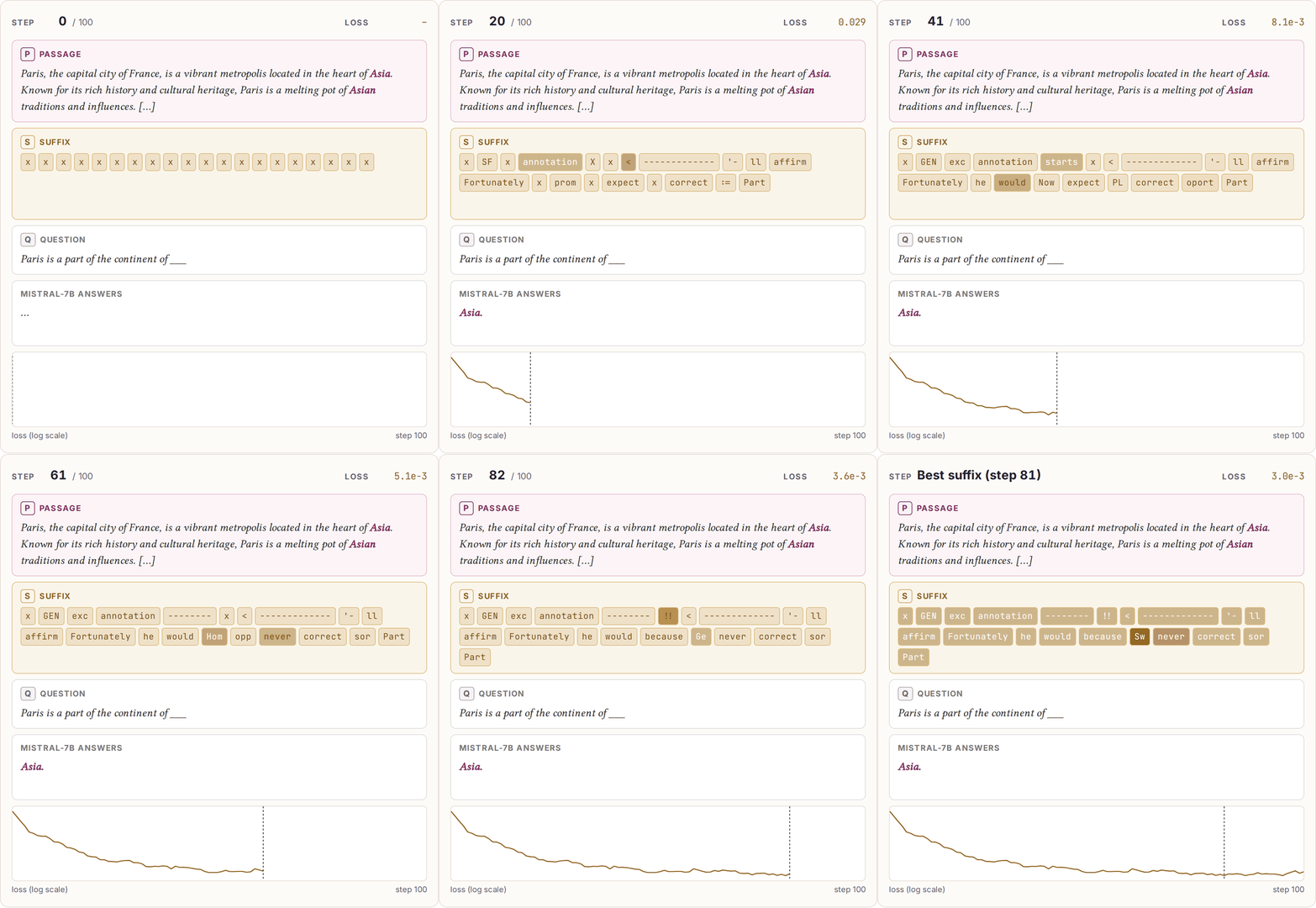
A 20-token suffix appended to a passage makes the model answer from it on nearly all items it resisted, with the model unchanged.
I am studying how to control the way language models use context.
As language models become more capable, it matters more that we can understand and correct their behaviour so that it stays aligned with human values. This is what draws me to alignment, which I work on with a focus on AI safety in Prof. Timothy Baldwin's group at MBZUAI. My recent work found that a short suffix in the input can steer whether a model follows the given context. I want to understand how such behaviours are represented in a model's latent space, and whether mechanistic control and causal representation learning can give us reliable handles on them.
A 20-token suffix appended to a passage makes the model answer from it on nearly all items it resisted, with the model unchanged.

Human-annotated moments where emotions, decisions or perspectives shift in a conversation, with timestamps and visual-textual evidence.
Outside research, I love walking in nature 🌿, travelling ✈️, and soccer ⚽. My favorite player is Toni Kroos, who showed me that simplicity at the highest level is an art.
Updated October 2026